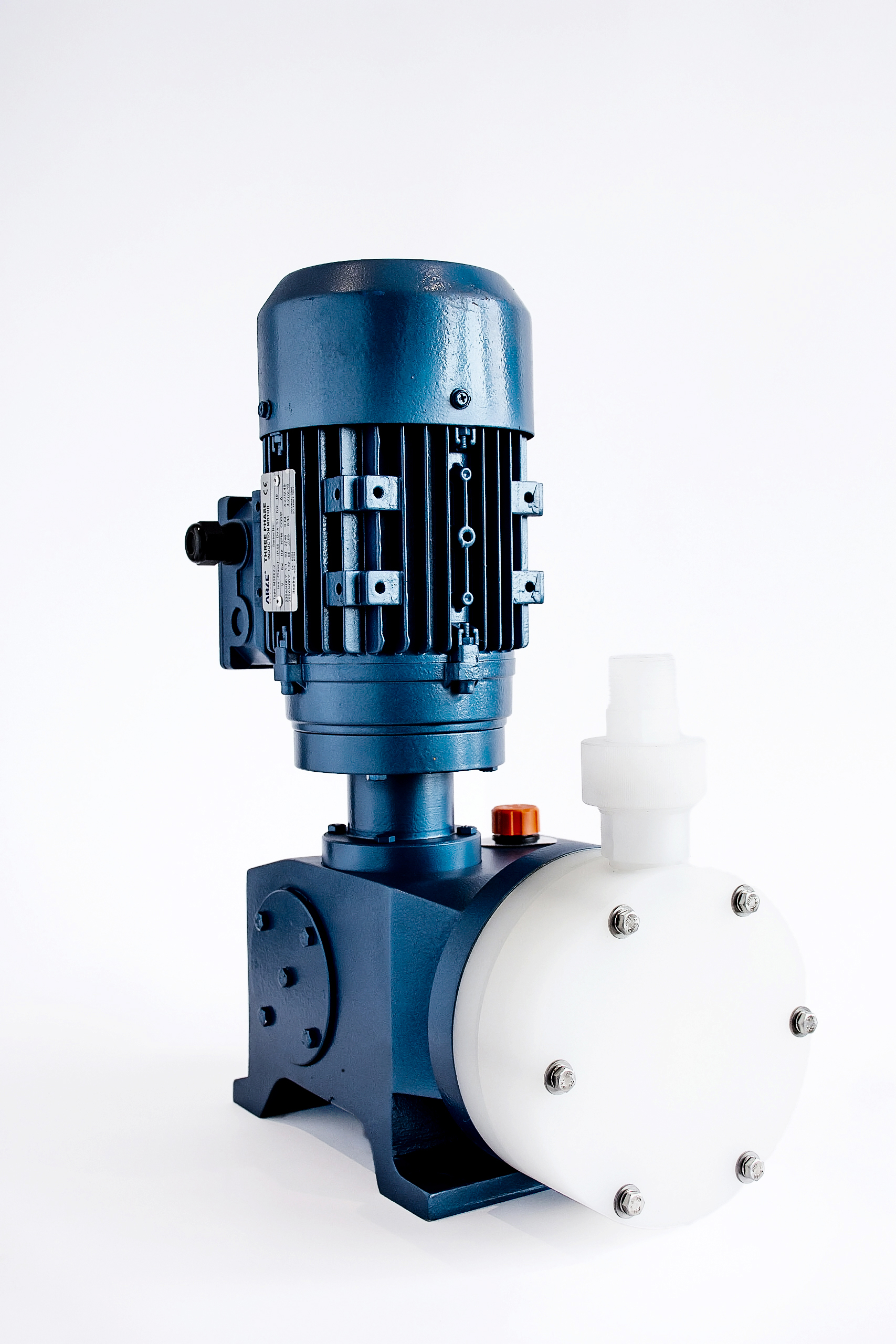
Fertigation & Chemigation Pumps
With roots in southern African agriculture, I-Feeder supports the preparation and injection stages of fertigation for centre pivot, lateral, drip and micro-irrigation applications. For African projects, contact the South African office to confirm equipment selection and the appropriate local support route.
I-Feeder fertigation and chemigation pumps deliver measured liquid into irrigation systems. Fertigation introduces fertilizer into irrigation water; chemigation introduces suitable treatment products through the irrigation system. The dosing equipment should be selected around the application, the chemical being handled and the operating conditions.
Measured injection for irrigation
Positive displacement metering pumps move a defined volume with each pumping cycle. Their output can be adjusted to suit the required dose within the selected pump’s operating range. Actual delivery must be calibrated under operating conditions: pressure, product viscosity, suction conditions, valve condition and the chosen controls can affect performance.
A dosing pump does not automatically maintain a constant fertilizer concentration when irrigation flow changes. Applications with variable water flow may require a flow signal and compatible proportional dosing controls. Match the control method to the irrigation system and confirm the delivered dose during commissioning.
Choose a pump around the duty
Required dose: calculate the injection rate from irrigation flow, target concentration and stock-solution strength.
Pressure: account for irrigation-line pressure, pipework losses and the required injection arrangement.
Compatibility: check the fertilizer or treatment product against the pump head, diaphragm, seals, valves and connected components.
Supply and control: specify available power, manual or automated operation and any flow, pH or EC control requirements.
Installation: assess suction conditions, filtration, calibration, pressure relief and backflow protection for the application.
Prepare the solution before dosing
Water-soluble fertilizer should be fully dissolved and evenly mixed before injection. Follow the fertilizer supplier’s mixing order, temperature and concentration guidance, and keep incompatible concentrated stocks separate. Explore I-Feeder fertilizer mixers and agitators or blowers and tank aeration assemblies for the preparation stage.
Build the complete system
Choose a standalone pump or discuss a turnkey fertigation system or packaged dosing skid. Fertigation automation and AgTech controls can support the required dosing workflow. For pump technologies and operating principles, see our positive displacement metering and dosing pumps.
Common selection questions
What is the difference between fertigation and chemigation?
Fertigation applies nutrients through irrigation. Chemigation is the broader application of suitable chemicals through irrigation. Product approval, compatibility, application instructions and protection requirements must be checked for the intended use.
Can one pump suit every fertilizer and irrigation system?
No. Required injection rate, discharge pressure, chemical compatibility and control method determine the appropriate selection. Supply these details so the duty can be assessed before a model is chosen.
What information should I send to I-Feeder?
Send the irrigation flow and pressure, tank and suction arrangement, fertilizer or chemical details, required application rate and available power. Contact I-Feeder for application selection or explore the I-Feeder digital tools.
How to size a fertigation pump for an African farm
Start with the irrigated area and the operating group that runs at the same time. A centre pivot, lateral, drip block or micro-irrigation zone needs its own dosing calculation. Do not combine sequential zones as though they operate together.
Step 1: Calculate the product required
For a liquid programme expressed in litres per hectare: product volume (L) = treated area (ha) × application rate (L/ha). The crop programme and product label determine the rate; pump sizing does not prescribe a nutrient or chemical programme.
Step 2: Calculate the injection rate
Required injection flow (L/h) = prepared solution volume (L) ÷ injection time (h). Use the final prepared volume if the product is diluted in a stock tank. For a mass-based programme, first convert the required mass using the actual stock-solution concentration.
Worked example: a 40-hectare operating group
This is an illustrative sizing example, not a customer result or application recommendation. At an assumed 5 L/ha, a 40 ha group requires 200 L of liquid product. If the final prepared solution is 800 L and the injection window is 4 hours, the required injection rate is 200 L/h. Select against that rate at the actual discharge pressure, with an appropriate operating range.
Step 3: Check the installation
Confirm pressure at the injection point, pipe losses, suction conditions, chemical compatibility and the available electrical supply. Allow for the irrigation operating sequence, including pressurisation and clean-water flushing as specified for the system and product.
Step 4: Commission and calibrate
Verify actual pump delivery under operating conditions and record the setting, liquid and pressure. Recheck after changes to the product, concentration or installation. If irrigation flow varies, discuss proportional control rather than assuming a fixed pump setting will maintain concentration.
Use the I-Feeder Calculator for preliminary sizing, then send the field and duty details to the African sales team for final selection. Use the technical library for model-specific instructions.