
Your Centre Pivot May Be Watering Correctly — But Is It Dosing Correctly?
A centre pivot can be applying water perfectly and still be doing a poor job of fertigation.
That is the part many growers overlook.
The pivot may move correctly. The sprinklers may look fine. The field may appear evenly covered. But if the dosing pump is incorrectly sized, poorly calibrated, worn, blocked, or not matched to the system flow rate, the crop is not receiving what the grower thinks it is receiving.
And that is where money gets lost.
Fertigation and chemigation through centre pivots can be powerful tools. They can save labour, reduce field passes, improve timing, and help place nutrients or crop protection products where they are needed.
But only when the dosing system is accurate.
When it is not, the grower is often left with expensive guesswork.
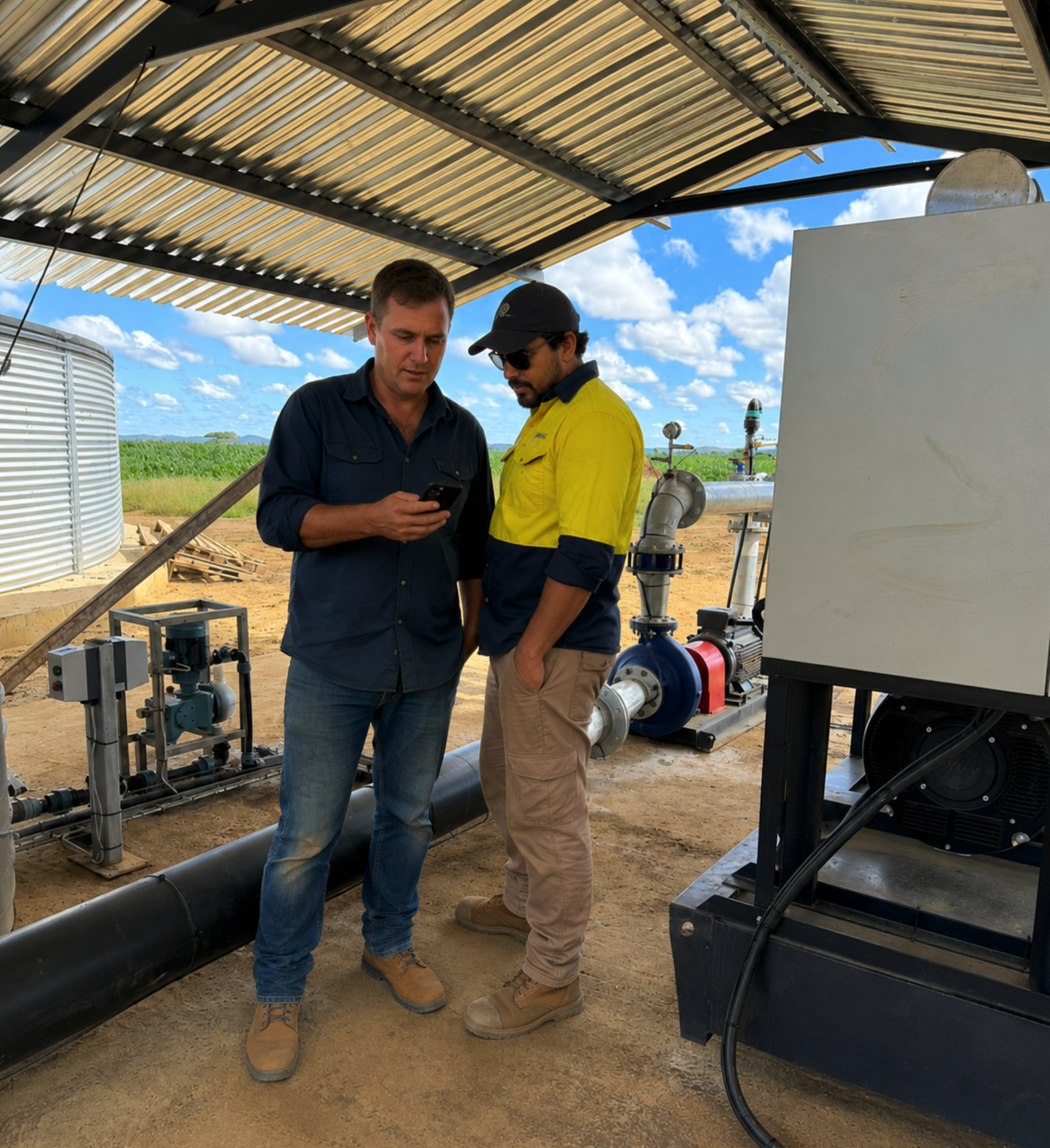
5 warning signs your pivot dosing may be wrong
1. The tank level does not match the application plan
If the product tank is emptying too quickly, too slowly, or inconsistently, the dosing rate may not be what you think it is.
This can happen because of incorrect pump settings, suction restrictions, worn components, air leaks, blocked filters, or pressure changes in the system.
A tank going down is not proof of accurate dosing. It only proves that product is leaving the tank.
2. The dosing pump is running, but nobody has recently calibrated it
This is one of the most common problems.
A pump can run and still inject the wrong volume.
Stroke settings, pump wear, pressure conditions, viscosity, suction lift, and chemical type can all affect actual delivery. Calibration should not be treated as a once-off setup task. It should be part of regular fertigation and chemigation practice.
If the pump has not been checked recently, the system is relying on hope.
3. The crop response is uneven across the field
Uneven crop colour, patchy growth, or inconsistent yield results are often blamed on soil, water or weather.
Sometimes that is true.
But poor injection accuracy or poor distribution through the pivot can also contribute. If nutrients or chemicals are not entering the water stream correctly, the pivot cannot apply them correctly.
The dosing system must work with the irrigation system, not as an afterthought attached to it.
4. Hoses, seals, valves and fittings are not being inspected
Small components can create large problems.
A cracked suction hose, worn seal, faulty non-return valve, leaking fitting or blocked injection point can compromise the whole system.
These failures are not always dramatic. Sometimes the system still appears to be working, while quietly delivering the wrong result.
That is why basic inspection matters.
5. There is no clear way to verify what was applied
This is becoming more important.
Growers increasingly need confidence, traceability and control. They need to know that the product was injected at the correct rate, during the correct irrigation window, and under the correct conditions.
If there is no simple way to verify dosing performance, the system is exposed to uncertainty.
And uncertainty is expensive.
What growers should check before the next application
Before using a centre pivot for fertigation or chemigation, growers should check:
Is the dosing pump correctly sized for the required application rate?
Has the pump been calibrated under real operating conditions?
Are suction lines, discharge lines, filters, seals and valves in good condition?
Is backflow protection installed and working correctly?
Is the chemical compatible with the pump, seals and pipework?
Is the injection point correctly positioned?
Does the tank drawdown match the intended application rate?
Is there a way to monitor or verify the application?
These checks are not complicated, but they are often skipped.
That is where problems start.
Accurate dosing is not a small detail
In fertigation and chemigation, small dosing errors can become big crop problems.
Too little product can mean poor crop response, wasted irrigation time and disappointing results.
Too much product can mean crop stress, wasted input cost, blocked equipment or compliance risk.
The centre pivot is only one part of the system. The dosing setup matters just as much.
A well-designed system should be accurate, safe, reliable and practical for the operator in the field.
The bottom line
Centre pivot fertigation is not just about connecting a tank and a pump to an irrigation system.
It is about control.
It is about knowing what is being applied, at what rate, and under what conditions.
At I-Feeder Global Dosing Systems, we focus on dosing system design for fertigation and chemigation applications where accuracy matters.
Because when fertiliser or chemicals are being applied through a pivot, “close enough” is not good enough.
Do you know what your pivot is actually dosing?